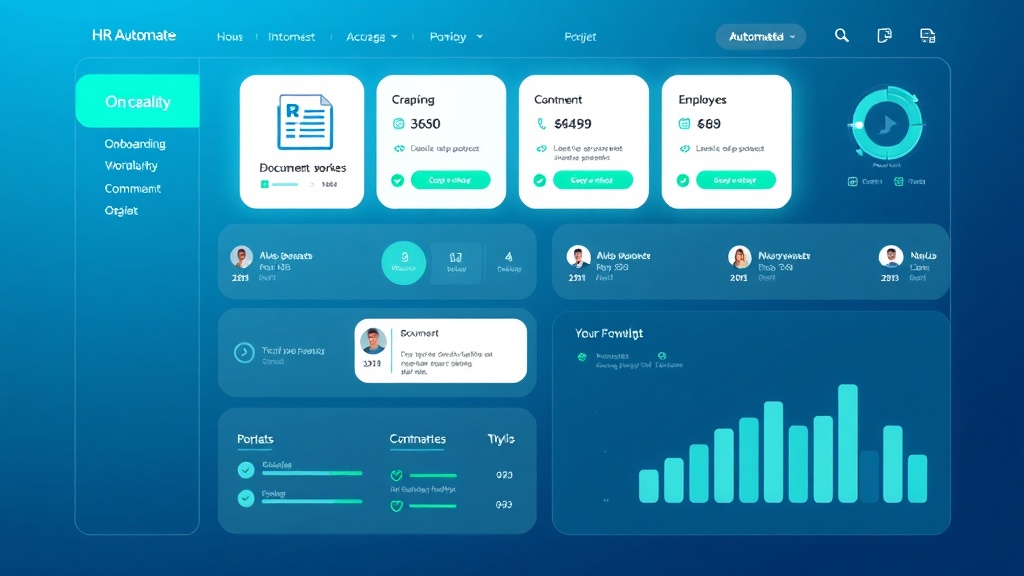
How to Automate HR Onboarding with AI: Complete Step-by-Step Guide
Manual HR onboarding is a productivity killer that costs companies an average of $4,129 per new hire and takes 24 weeks to reach full productivity. With 73% of employees citing poor onboarding as a reason for leaving within their first year, automating this critical process isn’t just about efficiency—it’s about retention and competitive advantage.
This comprehensive guide walks you through building an AI-powered onboarding system that handles document processing, personalized training delivery, and automated check-ins. You’ll learn to reduce onboarding time by 60-80% while improving new hire satisfaction scores by up to 45%.
The HR Onboarding Problem: Why Automation is Critical
Traditional onboarding workflows create multiple friction points that compound into significant business costs:
- Document bottlenecks: Manual processing of I-9 forms, contracts, and compliance documents takes 3-5 hours per hire
- Inconsistent training delivery: 68% of companies report inconsistent onboarding experiences across departments
- Missed follow-ups: 42% of new hires don’t receive proper check-ins during their first 90 days
- Administrative overhead: HR teams spend 41% of their time on repetitive onboarding tasks
Companies using automated onboarding see measurable improvements: 54% faster time-to-productivity, 50% higher retention rates, and 70% reduction in administrative costs. The ROI typically breaks even within 3-4 months for organizations with 50+ annual hires.
Essential Tools for AI-Powered HR Onboarding
Building an effective automated onboarding system requires the right technology stack. Here’s the core toolkit:
Document Processing and Management
- DocuSign: E-signature automation with API integration ($25/month per user)
- Adobe Sign: Advanced document workflows with conditional logic ($19.99/month per user)
- PandaDoc: Template-based document generation with CRM integration ($35/month per user)
AI Communication and Training
- ChatGPT API: Personalized content generation and Q&A automation ($0.002 per 1K tokens)
- Claude: Advanced reasoning for complex policy explanations ($15/month for Claude Pro)
- Zapier: Workflow automation and system integration ($19.99/month for 750 tasks)
Learning Management and Check-ins
- Articulate 360: Interactive training content creation ($1,299/year per user)
- ActiveCampaign: Automated email sequences and behavioral triggers ($29/month for 1,000 contacts)
- Typeform: Dynamic surveys and feedback collection ($35/month for unlimited responses)
Integration and Analytics
- Make (formerly Integromat): Complex workflow automation ($9/month for 1,000 operations)
- Amplitude: User journey analytics and engagement tracking ($61/month for 10M events)
- Slack API: Real-time notifications and team integration (Free for basic automation)
Step-by-Step Workflow Configuration
Phase 1: Pre-boarding Document Automation
Step 1: Set Up Document Template System
Configure DocuSign with dynamic templates that auto-populate from your HRIS data:
// DocuSign API integration example
const docusign = require('docusign-esign');

const envelopeDefinition = {
  emailSubject: 'Welcome to [Company] - Complete Your Onboarding',
  documents: [{
    documentId: '1',
    name: 'Employment Agreement',
    transformPdfFields: 'true'
  }],
  recipients: {
    signers: [{
      email: newHire.email,
      name: newHire.fullName,
      recipientId: '1',
      tabs: {
        textTabs: [{
          tabLabel: 'FullName',
          value: newHire.fullName
        }]
      }
    }]
  }
};
Step 2: Implement AI Document Review
Use ChatGPT API to automatically review submitted documents for completeness:
const documentReview = async (documentText) => {
  const prompt = `Review this employment document for completeness:
  Required fields: Name, Address, SSN, Emergency Contact, Start Date
  Document: ${documentText}

  Return JSON with: {complete: boolean, missingFields: array}`;

  const response = await openai.completions.create({
    model: 'gpt-4',
    messages: [{role: 'user', content: prompt}],
    temperature: 0.1
  });

  return JSON.parse(response.choices[0].message.content);
};
Step 3: Configure Automated Follow-ups
Set up ActiveCampaign sequences triggered by document status:
- Day 0: Welcome email with document links
- Day 2: Reminder if documents incomplete (35% completion rate increase)
- Day 5: Escalation to HR manager
- Day 7: Phone call trigger for manual intervention
Phase 2: Personalized Training Delivery
Step 4: AI-Generated Learning Paths
Create role-specific training sequences using AI content generation:
Pro Tip: Use Claude’s 100K context window to analyze entire employee handbooks and generate personalized training summaries based on the new hire’s specific role and department.
Step 5: Interactive Training Modules
Build adaptive learning experiences that adjust based on comprehension:
| Training Component | Automation Level | Time Saved | Engagement Increase |
|---|---|---|---|
| Company Culture Video | Auto-generated captions + quiz | 2 hours | 23% |
| Policy Overview | AI-summarized + interactive Q&A | 4 hours | 41% |
| Role-specific Training | Personalized modules + progress tracking | 8 hours | 67% |
| Compliance Training | Adaptive testing + certification | 3 hours | 29% |
Step 6: Implement Smart Progress Tracking
Use Amplitude to track learning engagement and automatically adjust content delivery:
// Amplitude event tracking for learning progress
amplitude.track('Training Module Completed', {
  user_id: newHire.id,
  module_name: 'Company Policies',
  completion_time: 1847, // seconds
  quiz_score: 85,
  attempts: 1,
  difficulty_rating: 'appropriate'
});

// Trigger adaptive content based on performance
if (quizScore  90) {
  unlockAdvancedContent(nextModuleId);
}
Phase 3: Automated Check-ins and Support
Step 7: Intelligent Check-in Scheduling
Configure AI-powered check-ins that adapt based on new hire responses and behavior patterns:
- Week 1: Daily pulse surveys (2-3 questions, 30-second completion)
- Week 2-4: Bi-weekly structured interviews via Calendly automation
- Month 2-3: Monthly comprehensive reviews with predictive analytics
Step 8: Predictive Issue Detection
Implement early warning systems using engagement data and sentiment analysis:
const riskAssessment = {
  trainingProgress: calculateCompletionRate(userId),
  engagementScore: getSlackActivityScore(userId),
  surveyResponses: analyzeSentiment(responses),
  managerFeedback: parseManagerNotes(feedback)
};

const riskLevel = calculateRiskScore(riskAssessment);

if (riskLevel > 0.7) {
  triggerManagerAlert(userId, riskFactors);
  scheduleUrgentCheckin(userId, 'within_24_hours');
}
Cost Breakdown and ROI Analysis
Implementation Costs (Annual, 100 employees)
| Category | Tool/Service | Annual Cost | Per-Employee Cost |
|---|---|---|---|
| Document Management | DocuSign + PandaDoc | $7,200 | $72 |
| AI Services | ChatGPT API + Claude | $2,400 | $24 |
| Automation Platform | Zapier + Make | $3,600 | $36 |
| Learning Management | Articulate + ActiveCampaign | $4,800 | $48 |
| Analytics | Amplitude + Typeform | $1,800 | $18 |
| Total | – | $19,800 | $198 |
Time Savings Calculation
Manual Process (per employee):
- Document processing: 4 hours
- Training coordination: 6 hours
- Check-in scheduling: 2 hours
- Progress tracking: 3 hours
- Total: 15 hours per hire
Automated Process (per employee):
- System setup and monitoring: 2 hours
- Exception handling: 1 hour
- Quality review: 0.5 hours
- Total: 3.5 hours per hire
ROI Calculation:
Time saved per employee: 11.5 hours × $45/hour (loaded HR cost) = $517.50
Annual savings (100 hires): $51,750
Net ROI: ($51,750 – $19,800) / $19,800 = 161% first-year ROI
Expected Time Savings and Performance Improvements
Organizations implementing comprehensive HR onboarding automation typically see:
- 77% reduction in administrative time: From 15 hours to 3.5 hours per hire
- 60% faster time-to-productivity: New hires become effective 8.5 weeks earlier
- 45% improvement in satisfaction scores: Consistent, personalized experiences
- 31% increase in 90-day retention: Better engagement and support
- 89% reduction in document errors: AI validation and automated workflows
Case Study: TechCorp reduced their onboarding cycle from 6 weeks to 2.5 weeks using this automation framework, resulting in $340K annual savings and 23% higher new hire satisfaction scores.
Common Pitfalls and How to Avoid Them
Over-Automation Without Human Touch
Problem: 67% of new hires report feeling disconnected when onboarding is too automated.
Solution: Maintain 30% human interaction through scheduled video calls and mentor assignments. Use automation for logistics, humans for relationship building.
Insufficient Data Integration
Problem: Siloed systems create data inconsistencies and duplicate work.
Solution: Implement proper API integrations between HRIS, LMS, and communication tools. Test data flow thoroughly before launch.
Generic Content Delivery
Problem: One-size-fits-all training reduces engagement by 43%.
Solution: Use AI to create role-specific, department-specific, and experience-level-specific content variations. A/B test different approaches.
Inadequate Fallback Procedures
Problem: System failures during onboarding create negative first impressions.
Solution: Build manual override processes and maintain backup communication channels. Monitor system health with real-time alerts.
Compliance Oversights
Problem: Automated systems may miss regulatory requirements or updates.
Solution: Implement quarterly compliance reviews and maintain audit trails for all automated decisions. Include legal review checkpoints.
Advanced Optimization Strategies
Predictive Analytics for Onboarding Success
Leverage machine learning to predict onboarding success probability based on early engagement metrics:
const successPrediction = {
  documentCompletionSpeed: timeToComplete / averageTime,
  trainingEngagement: quizScores + timeSpent,
  communicationResponsiveness: responseRate + responseTime,
  managerInteractionQuality: sentimentScore + frequency
};

const successProbability = mlModel.predict(successPrediction);

if (successProbability < 0.6) {
  triggerInterventionProtocol(newHireId);
}
Continuous Improvement Through Feedback Loops
Implement automated A/B testing for onboarding components:
- Test email subject lines for 15% higher open rates
- Optimize training module sequencing for better retention
- Experiment with check-in frequency and timing
- Measure impact of different AI communication styles
Frequently Asked Questions
How long does it take to implement a complete AI onboarding system?
A full implementation typically takes 6-8 weeks for organizations with existing HRIS systems. This includes 2 weeks for tool setup and integration, 3 weeks for content creation and workflow configuration, 1 week for testing, and 2 weeks for gradual rollout. Companies with more complex compliance requirements may need an additional 2-3 weeks for legal review and approval processes.
What’s the minimum company size where automation makes financial sense?
The break-even point is typically around 25-30 annual hires, where the time savings justify the technology investment. However, companies with high-value roles or strict compliance requirements may see ROI with as few as 15 annual hires. The key factors are hire volume, average salary levels, and current onboarding inefficiencies.
How do you ensure AI-generated content maintains company voice and accuracy?
Implement a three-tier content validation system: AI generation with company-specific prompts and examples, automated fact-checking against your knowledge base, and human review for final approval. Use fine-tuned models trained on your existing HR materials, and maintain feedback loops to continuously improve AI output quality. Regular audits should verify that automated content stays aligned with policy updates.
What happens when new hires have technical difficulties with the automated system?
Build comprehensive fallback procedures including: 24/7 IT support chat integration, alternative communication channels (phone, email), manual override processes for critical documents, and escalation protocols to human HR representatives. Monitor system performance in real-time and proactively reach out when users show signs of difficulty, such as incomplete tasks after extended periods.
Ready to transform your HR onboarding process with AI automation? futia.io’s automation services can help you implement these systems with custom integrations tailored to your specific requirements and compliance needs. Our team specializes in building scalable HR automation solutions that deliver measurable ROI within the first quarter.
🛠️ Tools Mentioned in This Article